Working example + reusable specification
HTTP Status Code Explorer AI Prompt
Build a static browser reference for common HTTP response codes with deterministic search, category filters, plain-language meanings, and no network requests.
01 / What it builds
A complete interaction, not a loose concept
Copy a complete AI coding prompt for an offline HTTP status reference with 1xx–5xx categories, search, copyable summaries, accessibility, and tests.
- 61 common status codes across 1xx–5xx
- Search by code, name, and description
- Category filtering and copyable summaries
- Offline operation with ephemeral queries
02 / Complete prompt
Copy the build specification
Project: HTTP Status Code Explorer

Objective
Build a fast, offline browser reference for common registered HTTP status codes with search, category filtering, clear explanations, and copyable summaries.

Functional Requirements
- Include a static curated dataset spanning informational, success, redirection, client-error, and server-error responses.
- Search case-insensitively by numeric code, reason phrase, and plain-language description.
- Filter by 1xx through 5xx category, combine category and search filters, and show the current result count.
- Render accessible result cards with the code, standard reason phrase, concise meaning, and a copy-summary action.
- Include a clear action that restores all 61 entries and focuses search.

Technical and Privacy Requirements
- Use semantic HTML, responsive CSS, vanilla JavaScript native modules, and immutable static data.
- Keep filtering and summary formatting pure and deterministic.
- Do not fetch URLs, probe servers, check live status, accept request headers, or imply network diagnostics.
- Store no queries or results and send no search text through analytics; record only fixed tool identifiers and action names.

Accessibility and Responsive Behavior
- Use visible labels, a live result count, ordered semantic results, keyboard-operable commands, and visible focus.
- Maintain 44px command targets and a one-column result layout without horizontal overflow at 320px.

Acceptance Criteria
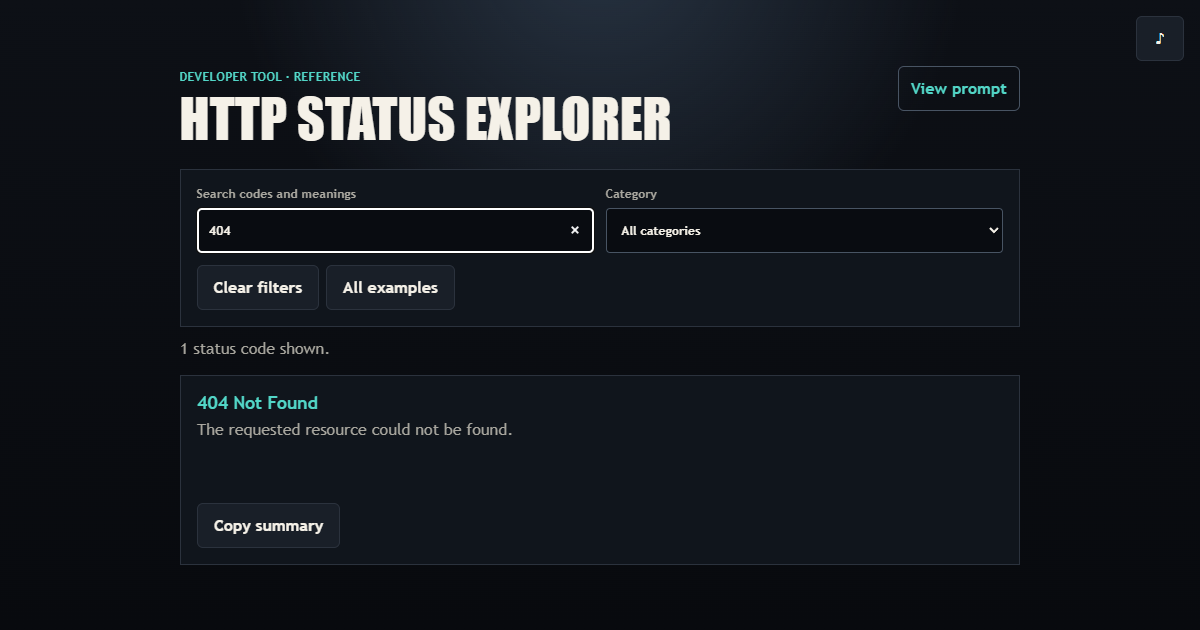
- Searching 404 returns Not Found and searching rate limit returns 429 Too Many Requests.
- Category filters contain only codes in the selected hundred range and combine correctly with text search.
- Invalid category input falls back to all categories; clearing restores the full dataset.
- Automated tests cover dataset shape, code/name/description search, category combinations, summaries, launch, clear, and mobile layout.

Deliverables
- The complete offline explorer as the primary experience, static domain data, a browser controller, and focused tests.
- No backend, account, network requests, runtime dependency, or persistence.

Provided by www.my-ai-prompts.com