Working example + reusable specification
Reaction Time Test AI Coding Prompt
Build an accurate browser reaction test with explicit phases, monotonic timing, premature-input handling, performance classifications, and validated attempt history.
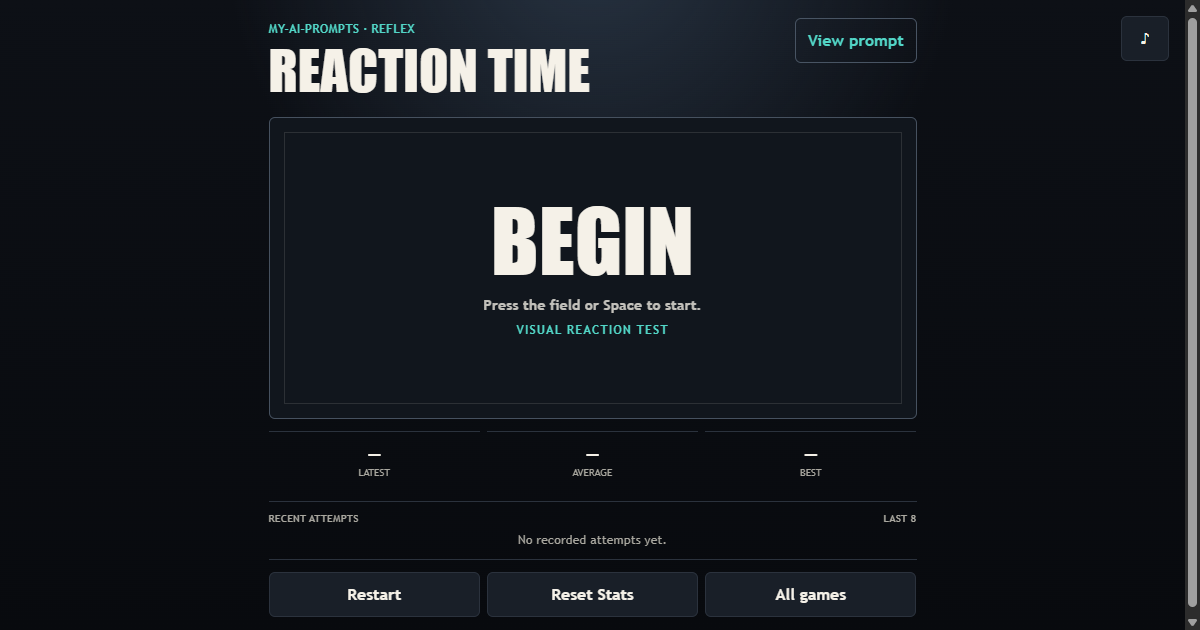
01 / What it builds
A complete interaction, not a loose concept
Copy a complete AI coding prompt for a visual reaction time test with accurate timing, early-click detection, statistics, accessibility, and tests.
- Monotonic millisecond timing
- Early-click detection and cancellation
- Average, best, and recent-attempt statistics
- Pointer, touch, and keyboard input
02 / Complete prompt
Copy the build specification
Project: Reaction Time Test

Objective
Build a complete visual reaction test that measures valid responses accurately, distinguishes premature input, summarizes performance, and preserves validated attempt history.

Functional Requirements
- Implement explicit Ready, Waiting, Green, and Result phases.
- Start each signal after a random delay from 1.8 to 5 seconds.
- Detect early input, cancel the pending signal, and show clear "Too early" feedback without recording an attempt.
- Measure valid reactions in milliseconds using a monotonic browser clock.
- Show latest time, rounded running average, best time, and the eight most recent attempts.
- Classify results as Elite below 180 ms, Very Fast from 180–219 ms, Average from 220–280 ms, Below Average from 281–350 ms, and Slow from 351 ms onward.
- Persist validated attempt history in localStorage and provide Restart and Reset Stats actions.

Technical Requirements
- Use semantic HTML, responsive CSS, and vanilla JavaScript with native modules.
- Keep timing rules and statistics independent from DOM, timer, audio, and storage effects.
- Use a monotonic browser clock for elapsed-time measurement.
- Cancel timers and timing state when restarting or leaving the game.

Accessibility and Responsive Behavior
- Support pointer, touch, and Space without accidental scrolling or repeated-key activation.
- Include accessible live feedback, visible focus, reduced-motion support, and stable mobile and desktop layouts.

Acceptance Criteria
- Early input records no attempt and prevents the canceled signal from appearing later.
- A valid result equals the elapsed monotonic time between signal presentation and accepted input.
- Classification boundaries match the specified millisecond ranges exactly.
- Statistics use only valid attempts and retain at most the eight most recent values.
- Reloading restores valid history and rejects malformed persisted data.
- Deterministic automated tests cover timing boundaries, classifications, early input, statistics, persistence, keyboard input, and lifecycle cleanup.

Deliverables
- The complete playable test as the primary experience, not a landing page.
- Modular application source and focused automated tests.
- Concise instructions for running and testing the project locally.

Provided by www.my-ai-prompts.com